Tuesday, July 9, 2013

July 9: SS. John, O.P., and Companions , Mm., III Cl.

On this day, in the 1962 Dominican Rite Calendar, we celebrate the Feast of SS. John of Cologne, O.P., and companions, the Martyr's of Gorcum.  


From the III Lesson of Matins:


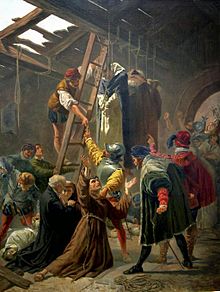
The sixteenth century, memorable for the disturbances of the error of Calvinism, provided in Holland a striking example of christian fortitude.  The nineteen martyrs of Gorcum, as they are called, strove gloriously in defense of the Real Presence of Christ's body in the Eucharist and the Primacy of the Roman Pontiff.  Among these was John, of the Order of Preachers, an alumnus of the house at Cologne.  At the direction of his superiors, he had been administering the parish of Hoornaer in Holland.  Having gone to the town of Gorcum to baptize an infant, he was taken by Calvinist followers and thrown into prison.  There he shared the lot of other priests and religious already imprisoned for the faith.  For several days and nights, their constancy was tried by various forms of ridicule and ill-treatment.  Then, half naked, they were taken by boat to Briel, and, on the way, suffered incredible tortures at the hands of the soldiers, the sailors, and the heretical mob.  Finally, they were hanged from a beam and strangled, thus receiving the palm of martyrdom on July 9 in the year 1572.  Renowned for miracles, they were canonized by Pius IX.

From the Office of Lauds:


Night now is over, rising sun casts splendor
Over the triumph of those valiant soldiers
Fallen in battle on the field of Gorcum; 
Great in their courage!
Joyously rising, they ascend the heavens.
God, himself, greets them in celestial mansions;
There does he crown them with his light eternal;
He is their glory.
Earth, too, applauding, tells the martyr's story,
Name of these victors flies through every nation;
Fame, then, resulting, in a praise most worthy,
Signs of their merits.
O worthy offfspring of Christ's holy martyrs,
With brows encircled by triumphal garlands!
Hear, and be mindful of your own who praise you:
By your prayer, save us.
Might, honor, power, be to God the Father;
Give worship, likewise, to the Son forever;
And to the Spirit, sing, with voice unceasing,
Hymns in his praises.
Amen. 

Collect Prayer


O
 God, you crowned with the laurel of immortality the struggle made for the faith by your blessed martyrs, John and his companions; mercifully grant that, striving here on earth, we may likewise deserve, through their merits and following their example, to be crowned with them in heaven.  Through Our Lord… 

Sunday, July 7, 2013

July 7: Blessed Benedict XI, Pope, Confessor, O.P., Commemoration


Today, in the 1962 Dominican Rite Calendar, we celebrate the commemoration of Blessed Benedict XI, one of the four Dominican Popes.  From “Short Lives of the Dominican Saints” (London, Kegan Paul, Trench, and Trübner & Co., Ltd., 1901).

Nicholas Boccasino, who assumed the name of Benedict XI, when raised to the Pontifical dignity, was born of poor parents at Treviso in Italy, A.D. 1240.  He received his early education form an uncle, who held the office of parish priest, and at the age of fourteen was admitted into the Dominican Order at Venice.  The next fourteen years of his life were devoted to prayer and study, after which he was employed in teaching sacred science to his Brethren.  He never allowed his lessons to interfere with his exercises of piety or to prevent him from teaching the Word of God; and he also found time to write some learned commentaries on various parts of Scripture, and other valuable works.
After successively filling the offices of Sub-Prior and Prior and that of Provincial of Lombardy, he was unanimously elected General of the Order, A.D. 1296.  During the two years and a half that he held this charge, the holy General ceased not to visit the Convents of the Order, always traveling on foot and encouraging his companions to face danger and fatigue by exclaiming:  “Come, dearest Brethren, this is the glory of our Order.”  Rigid and austere to himself, he was the gentlest of religious Superiors towards his subjects.  Contemporary historians call him “the lover of the Community,” and are never weary of praising his virtues, and above all, his singular humility of heart.

In January A.D. 1299, Pope Boniface VIII, whose cause he had stoutly defended, created him Cardinal Priest of the title of Santa Sabina.  “Holy Father,” he exclaimed, throwing himself at the Pope’s feet, “why have you laid so heavy a burden upon me?”  “God has a yet heavier one in store for you,” was the prophetic reply.  Two years later, he was promoted to the bishopric of Ostia and Velletri, made Dean of the Sacred College, and sent as Legate to Hungary, which was at that time in a very disturbed condition.  On his return to Italy, he found the Pope surrounded by enemies, the creatures of Philip the Fair of France, and had the glory of standing by the Holy Father’s side at Anagni in company with only one other Cardinal, when he was brutally assaulted and dragged from his throne.  The Cardinal of Santa Sabina succeeded in stirring up the inhabitants of Anagni to expel the sacrilegious rebels from their town, but the Pope did not long survive the outrages he had received, dying almost immediately after his return to Rome.

File:C o a Benedetto XI.svg
Benedict XI Coat of Arms

The Cardinals assembled in conclave eleven days after the death of Boniface, and unanimously elected Cardinal Nicholas Boccasino as his successor, A.D. 1303.  He assumed the name of Benedict out of veneration for his predecessor, who had borne that name before his elevation to the Papacy, and took for his motto those words of the Psalmist: “Make Thy face to shine upon Thy servant” (Psalm 118, 135).  Europe was in a very troubled state at the commencement of the new Pontificate; but the admirable prudence and energy of the Pontiff did much for the restoration of peace and order.  In particular, he succeeded in reconciling France with the Holy See and in restoring the Papal authority of Sicily and Denmark; and he greatly exerted himself to induce the princes of Christendom to lay aside their mutual differences and engage in a crusade against the infidels.

Shortly after his elevation to the Pontifical throne, his mother came to pay him a visit.  The magistrates of Perugia, where he was then residing, on hearing of her arrival, received her with great pimp, arrayed her in costly apparel, and conducted her to the Papal presence.  But, when the Holy Pontiff saw his mother richly dressed an accompanied by a splendid retinue, he refused to recognize her, saying:  “My mother was only a poor washerwoman, and not a princess like this.”  Then she retired, laid aside her silk garments, and returned in the humble garb of a peasant woman.  When Benedict saw her thus, he came down from his throne to meet her, embraced her tenderly, and showed her every mark of respect and affection.

Benedict’s reign, marked with vigor, justice, and clemency, unhappily lasted only eight months.  His death, which took place at Perugia on the 7th of July, A.D. 1304, was believed to be the effect of poison, given him in some figs which had been presented to him by an unknown person.  He was buried in the church of his Order at Perugia, and many miracles were worked at his tomb.  He was beatified by Pope Clement XII.

From the "The Martyrology of the Sacred Order of Friars Preachers" (Tr. by Rev. W. R. Bonniwell, O. P., The Newman Press - Westminster, Maryland, 1955):


"At Perugia, Blessed Pope Benedict XI of Treviso, confessor, of the Order of Preachers. In the short space of his pontificate, he did much to promote peace for the Church, to restore discipline, and to increase religion to a wonderful degree."

Prayer

O
 God, by the grace of your blessing, you raised to heaven the blessed pontiff Benedict; sanctify your people, we pray, with a further blessing of your grace, and, by his merits and prayers, defend us, in your strength, from all threatening evils.  Through Our Lord…

Sunday, June 30, 2013

The Rosary

There is no such thing as a time or place that is not suitable for the Rosary.


Friday, June 28, 2013

June 28: Vigil of Ss. Peter and Paul, II Class

Today, in the 1962 Dominican Rite Calendar, is the Vigil of Ss. Peter and Paul.  It is a II Class Vigil.  According the the rubrics of the 1962 Breviarium Iuxta Ritum Sacri Ordinis Praedicatorum, all is prayed as if this were a ferial day, with the following exceptions.  At Matins, the Lessons are proper and are given in the Proprium Sanctorum.  Also, since it is a II Class vigil, at Lauds the Psalms of Scheme II are prayed.  At Pretiosa, the Gospel for the Vigil is read.

Thursday, June 27, 2013

Dominican Rite Mass in Columbus, OH


A Missa Canta, according to the Dominican Rite, will be celebrated on Sunday, August 4, 2013 at 2:00 PM at St. Patrick Catholic Church, 280 N. Grant Avenue, Columbus, OH.  The celebrant will be Fr. Austin Litke, O.P.


This Mass is open to the publish and is the second public celebration of the Dominican Rite in the Dominican Parish of St. Patrick's since Pope Benedict XVI's issuance of the motu proprio Summorum Pontificum.  In the 1962 Dominican Rite Calendar, August 4 is the Feast of Our Holy Father, St. Dominic, which takes liturgical precedence of the Mass of Sunday (so your Sunday obligation is fulfilled).

Saturday, June 22, 2013

June 22: Blessed Innocent V, P, C, O.P., Comm.

Today, in the 1962 Dominican Rite Calendar, we celebrate the commemoration of Blessed Innocent V, one of the four Dominican Popes.  From “Short Lives of the Dominican Saints” (London, Kegan Paul, Trench, and Trübner & Co., Ltd., 1901):

File:C o a Innocenzo V.svg
Coat of Arms of Bl. Innocent V

Blessed Innocent V., known before his elevation to the Papacy by the name of Peter of Tarantaise, was born of noble parents at that town, situated at the foot of the Alps, on the confines of Savoy, a territory then dependent on the Dukes of Burgundy, about A.D. 1225.  Whilst still quite a child, he was sent to study at the University of Paris, where he received the Dominican habit from the hands of Blessed Jordan, the second Master-General of the Order of Preachers, when only nine years old.  He is believed to have been one of those young postulants admitted on occasion of the General Chapter of 1234.  To the remonstrances of the capitular Fathers, who complained that these children were so ignorant of Latin as scarcely to be able to read a lesson of Matins even after much previous preparation, the holy Master-General gently replied: “Suffer these little onese to come, and forbid them not.  Know that you will see many, yea, most of them, acquit themselves gloriously of the office of preaching; and God will make use of them for the work of saving souls, in preference to many others of cultured mind.”  In none was this prophecy more brilliantly fulfilled than in little Peter of Tarantaise.  To the extraordinary beauty of person he joined the highest gifts of mind and heart; and in the shadow of the cloister, like the child Jesus in the holy house at Nazareth, he daily “grew in wisdom, and age, and grace with God and men.”  When only twenty-eight, he was judged capable of teaching theology in the University at the same time as his intimate friend, Saint Thomas Aquinas; and we are particularly told that his merit was not in the least eclipsed by that of the Angel of the Schools.   He also composed Commentaries on the Four Books of the Sentences of Peter the Lombard and on Holy Scripture, and other learned works, which in their day were scarcely less prized than those of Saint Thomas himself.  Hence, in the year 1259, he was chosen with [Saint] Albert the Breat, Saint Thomas, and two other distinguished religious, to draw up a general plan of studies to be followed in all Dominican schools.

InnocenzoV.jpg

At the age of forty, his rare prudence, his knowledge of men, his admirable meekness, and his invincible firmness, caused him to be elected Provincial of his Order in the Province of France, which then numbered dome fifty Convents.  His journeys in the visitation of his Province were always made on foot, with the simplicity of a poor Friar; he everywhere diffused the good odor of his virtues and kept alive primitive fervor and zeal for souls in the hearts of his Brethren.  Meanwhile, the masters and students at the University of Paris, who deeply regretted his absence, earnestly begged to have him back among them.  The General Chapter of the Order granted their petition, and Father Peter returned to Paris where he took his doctor’s degree and succeeded Saint Thomas at the head of the School.  In the year 1269, however, he was re-elected Provincial.  Three years later, Blessed Gregory X., who then filled the Chair of Saint Peter and who had formerly been one of his pupils at Paris, appointed him Archbishop of Lyons and Primate of France.  A few months later, he raised him to the dignity of Cardinal at the same time as the great Franciscan, St. Bonaventure, and made him Bishop of Ostia and Velletri and Dean of the sacred College, commanding him to continue the administration of the Archdiocese of Lyons until the nomination of his successor in that see.

The saintly Pontiff employed the new Cardinal to assist him in making preparations for the General Council which he had convoked at Lyons, for the purpose of effecting a re-union between the Greek and Latin Churches, and organizing a fresh Crusade for the recovery of the Holy Land.  The Council opened on May 7, 1274.  Cardinal Peter of Tarantaise took a distinguished part in its proceedings and displayed an extraordinary talent for business.  He was especially charged with all that concerned the re-union of the Greeks with the Latins, and succeeded in inducing the ambassadors of the Greek Emperor to submit to the faith and authority of the Roman Church.  It fell to his lot to preach the funeral sermon of his friend and colleague, Saint Bonaventure, who died at Lyons during the Council;  and he did so with a touching eloquence which caused the whole of his audience to mingle their tears with his own.

In January, A.D. 1276, Blessed Gregory X died, and Cardinal Peter of Tarantaise was unanimously elected as his successor, assuming the name of Innocent V.  The holy man immediately set himself to labour zealously for the peace of Christendom, the repression of the Moors, who were threatening a fresh invasion of Spain, the acceptance by the Greeks of the adhesion of their ambassadors to reunion with the Roman Church, and the undertaking of a fresh Crusade against the infidels.  Such splendid beginnings excited the greatest hopes for the new Pontificate, but it was doomed to be of brief duration.  On June 22nd, and attack of malignant fever closed the holy Pontiff’s career; he had sat in the Chair of Peter only five months and two days.  He was laid to rest in the Lateran Basilica, and rendered himself illustrious by a host of miracles.  Pope Leo XIII, raised him to the Altars of the Church, A.D. 1898.

From the "The Martyrology of the Sacred Order of Friars Preachers" (Tr. by Rev. W. R. Bonniwell, O. P., The Newman Press - Westminster, Maryland, 1955):

At Rome, Blessed Innocent V, pope. Previously he had been known as Friar Peter of Tarantaise, of the Order of Preachers. He excelled in both learning and sanctity. He was made Archbishop of Lyons and later Cardinal Bishop of Ostia; finally, he was elected pope. He labored with suave prudence to protect the liberty of the Church and to promote concord among Christians. His fame was spread by many miracles both in life and after death.
Prayer
O

 God, you enriched your bishop and confessor, the blessed Innocent, with the gifts of knowledge and prudence, and made him a promotor of peace and unity; grant, through his prayers, that we may relish what is heavenly, and in perfect concord follow what is right.  Through Our Lord… 

Thursday, May 30, 2013

Feast of the Most Holy Body of Christ (1st Class)

At the end of the propers for Wednesday after Trinity Sunday, in the Dominican Breviary, the following rubric appears:
The feast of Corpus Christi is celebrated.  The Office was composed by St. Thomas Aquinas.
Ben XVI Corpus Dni.jpg
In his book “The History of the Dominican Liturgy”, Fr. Bonniwell, O.P., relates the tale of how there was much confusion, in modern times, over whether or not St. Thomas actually composed the office for the Feast of Corpus Christi.  Thankfully, the controversy was settled in favor of St. Thomas' authorship of the Office for the Feast.  As Dr. Martin Grabmann concluded,
"We can therefore regard the office of Corpus Christi as the genuine composition of St. Thomas Aquinas, it being in regard to its contents and constituent parts the product of his genius and intellect" (Bonniwell, p. 226, footnote).

Some of the distinctive features of the Office of the Feast of Corpus Christi, in the Dominican Breviary are:

The responsory at 1st Vespers:
.  A man once gave a great banquet, and sent his servant to say to those who had been invited, “Come * for all is now ready” .  Come, eat of my bread and drink of the wine I have mixed. – For all is now ready. – Glory. – For all is now ready.
The Nunc dimittis antiphon at Compline:
Alleluia.  The bread which I shall give, alleluia, is my flesh, for the life of the world, alleluia, alleluia.
The versicle and response at the beginning of Lauds:

. I eat my honeycomb with my honey, alleluia. .  I drink my wine with my milk, alleluia.
During these days, when belief in the Real Presence is at tragically low levels among even Catholics who attend Mass regularly, we implore you, St. Thomas Aquinas, to pray for us.