Showing posts with label 1909 Breviarium S.O.P.. Show all posts

Friday, May 22, 2026

LOST FEAST: May 22: St. Servatius, B.,C., Protector of the Order

One of the feasts removed from the Dominican calendar during the early 20th Century was that of St. Servatius, a 4th Century bishop who lived in Gaul.  He was an unofficial protector of the Order of Preachers.  In the 1909 Dominican Breviary, his feast is a totum duplex.  In his book, "The History of the Dominican Liturgy", Fr. William Bonniwell, O.P., disputes the circumstances surrounding the legendary intervention by St. Servatius at the Chapter at Cologne.  You can find his argument here (beginning on p. 242).

Friday, October 31, 2025

LOST FEASTS: October 31 - Commemoration of the Holy Relics

One of the great tragedies of the 20th century liturgical changes was the "Romanization" of the Dominican calendar that occurred in the revision of 1960, and which is codified in the calendar of the 1962 Breviarium iuxta ritum sacri ordinis praedicatorum. Many wonderful Dominican feasts were removed from the liturgical calendar of the Order, including those of many Dominican blessed's and many other feasts that were particular to the Dominican Order.  One such feast was the Feast of the Holy Relics.


As noted in the Martyrology of the Sacred Order of Friars Preachers (Bonniwell, 1955), this feast was a commemoration of "holy martyrs and of the other saints, whose bodies or relics are preserved in our churches." In the 1909 Breviarium iuxta ritum sacri ordinis praedicatorum the feast is celebrated on October 30, however in the 1924 Breviarium S.O.P. it appears on October 31, the Vigil of All Saints Day, and remained there until it was removed in 1960. The feast had the rank of a totum duplex feast, which in 1962 would have been considered a 1st Class Feast. For the Office, everything was taken from the Common of Many Martyrs, except the Collect (see below), and lessons 4, 5, and 6 at Matins, which were taken from a tract by St. John Damascene's "De Fide Orthodoxa" . A commemoration of St. Quintinus was also made. Interestingly, this feast superseded the Vigil of All Saints at Matins, as noted in the 1924 Breviarium S.O.P., which states "De Vigilia Sanctorum in Officio nihil fit" at the end of the Office.

Sunday, August 3, 2025

August 3: The Vigil of the Feast of St. Dominic

After weeks of preparation, including the 15 Tuesday's devotion to St. Dominic, and the Novena to our Holy Father, we have arrived at the eve before his feast day! (Yes...I know this is not an actual "vigil").  Traditionally, this was also a day of fasting and abstinence for Tertiaries of our Order.  At Pretiosa today, we announce the feast to be celebrated tomorrow:

At Bologna, our most holy Father St. Dominic, confessor and founder of the Order of Friars Preachers. He was most illustrious, being distinguished by nobility of birth, sanctity and learning. Until death he preserved without stain his virginity and by the singular grace of his merits he raised three persons from the dead. By his preaching he curbed heresies and established many persons in a religious and godly manner of life. On August 6, his soul soared to heaven, there to receive a reward commensurate with his extraordinary works. His feast, however, is celebrated on this day, by an ordinance of Pope Paul IV. A totum duplex feast of the first class with a solemn octave.

That last sentence is a holdover from the pre-1961 calendar, when a solemn octave was celebrated for 8 days after his feast day. On August 5, I will be posting on the manner of celebrating the octave of his feast according to the 1909 Breviarium juxta ritum sacri ordinis praedicatorum.

The office begins at 1st Vespers with the super psalm antiphon....Gaude (O happy parent, Spain,...), followed by the special arrangement of Psalms that are used in the Dominican Office for 1st Class feasts (Psalms 112, 116, 145, 146, & 147, a.k.a, the "laudate Psalms).  Since it is a Sunday, a commemoration is made of 2nd Vespers of the Eighth Sunday after Pentecost.  

Saturday, June 28, 2025

June 28: Vigil of Sts. Peter & Paul - Domine Quo Vadis?

A few years ago, I read the "The Interior Castle" by St. Teresa of Avila.  For anyone who has not read it, I highly recommend it.  It is a beautiful work, in which she gives us the benefit of her deep and penetrating knowledge into the life of prayer, and demonstrates her extraordinary insight into human frailty and the stumbling blocks which hinder us on our path toward spiritual perfection.

In the last chapter (7th Mansion, Ch. 4), as she is recapping the book, and speaking of the trials and sufferings of those to whom Our Lord grants intense spiritual visions and aspirations, she mentions the famous "Quo vadis" legend regarding St. Peter.  The translator of the edition that I was reading (E. Allison Peers, Sheed & Ward, 1946) puts a footnote there, and states:
"In the old Carmelite breviary, which St. Teresa would have used, the Antiphon of the Magnificat at 1st Vespers on June 29 runs "The Blessed Apostle Peter saw Christ coming to meet him.  Adoring Him, he said: 'Lord, whither goest Thou?' ' I am going to Rome to be crucified afresh.'"  The story has it that St. Peter returned to Rome and was crucified.
Since the Carmelite and Dominican liturgical books sprang from the same medieval use that was widely diffused throughout France in the 13th Century, I decided to look up June 29 in my Dominican Breviary (1967) to see if that antiphon had survived through the centuries.  And sure enough, it did.  (See here...bottom left side of p. 574.)

Than antiphon at 1st Vespers for the Feast of Sts. Peter and Paul is:

Beátus Petrus Apóstolus vidit sibi Christum occúrrere, et adórans eum ait:  Dómine, quo vadis?  Vénio Romam íterum crucifígi.
The blessed apostle Peter saw Christ coming towards him, and adoring him, said, “Lord, where are you going?” “I go to Rome to be crucified again.”

This antiphon is not in the 1962 Monastic or Roman breviaries.  Whether or not the legend is true, it has been borne through the ages in the Dominican breviary and is, in my opinion, a wonderful subject for meditation.  This is particularly true in these dark days when living a faithful Catholic life can at best be full of obstacles and, at worst, lead to outright persecution by the State or groups who align themselves with the eternal Enemy of the Church.

Thursday, May 22, 2025

LOST FEAST: May 22: St. Servatius, B.,C., Protector of the Order

One of the feasts removed from the Dominican calendar during the early 20th Century was that of St. Servatius, a 4th Century bishop who lived in Gaul.  He was an unofficial protector of the Order of Preachers.  In the 1909 Dominican Breviary, his feast is a totum duplex.  In his book, "The History of the Dominican Liturgy", Fr. William Bonniwell, O.P., disputes the circumstances surrounding the legendary intervention by St. Servatius at the Chapter at Cologne.  You can find his argument here (beginning on p. 242).

Wednesday, November 13, 2024

LOST FEASTS: November 13 - St. Thomas Aquinas - Patron of Catholic Schools

In the annals of the traditional Dominican liturgical calendar, this feast may rank as one of the shortest lived.  In the early 20th century, rather than celebrating the VI Sunday after the Epiphany yesterday, the Order would have celebrated the feast of St. Thomas Aquinas - Patron of Catholic Schools.


One year after his landmark engyclical Aeternis Patris on the philosophical and theological methods of St. Thomas Aquinas, Pope Leo XIII declared:

“We, for the glory of Almighty God and in honor of the Angelic Doctor, for the increase of the sciences, and for the common benefit of human society, declare by Our Supreme Authority , that St. Thomas Aquinas is Patron of Studies in Universities, Colleges, Lyceums, and Catholic Schools; and We desire that he be so held by all…” "Cum hoc sit", Brief of Leo XIII, August 4, 1880.
Beginning with the 1924 Breviarium iuxta ritum sacri ordinis praedicatorum, November 13 was the feast of St. Thomas Aquinas - Patron of Catholic Schools in the Dominican liturgical calendar. Fr. Bonniwell's "History of the Dominican Liturgy" gives no date for when exactly the Order adopted this feast. 

Thursday, October 31, 2024

LOST FEASTS: October 31 - Commemoration of the Holy Relics


One of the great tragedies of the 20th century liturgical changes was the "Romanization" of the Dominican calendar that occurred in the revision of 1960, and which is codified in the calendar of the 1962 Breviarium iuxta ritum sacri ordinis praedicatorum. Many wonderful Dominican feasts were removed from the liturgical calendar of the Order, including those of many Dominican blessed's and many other feasts that were particular to the Dominican Order.  One such feast was the Feast of the Holy Relics.

As noted in the Martyrology of the Sacred Order of Friars Preachers (Bonniwell, 1955), this feast was a commemoration of "holy martyrs and of the other saints, whose bodies or relics are preserved in our churches." In the 1909 Breviarium iuxta ritum sacri ordinis praedicatorum the feast is celebrated on October 30, however in the 1924 Breviarium S.O.P. it appears on October 31, the Vigil of All Saints Day, and remained there until it was removed in 1960. The feast had the rank of a totum duplex feast, which in 1962 would have been considered a 1st Class Feast. For the Office, everything was taken from the Common of Many Martyrs, except the Collect (see below), and lessons 4, 5, and 6 at Matins, which were taken from a tract by St. John Damascene's "De Fide Orthodoxa" . A commemoration of St. Quintinus was also made. Interestingly, this feast superseded the Vigil of All Saints at Matins, as noted in the 1924 Breviarium S.O.P., which states "De Vigilia Sanctorum in Officio nihil fit" at the end of the Office.

Wednesday, December 6, 2023

December 6: St. Nicholas, B., C., III Class

Per tradition, I always post on what I see as "links" between St. Nicholas, who's feast we celebrate today, and the Dominican Order.  The feast of St. Nicholas, Bishop of Myra, is one of my favorite non-Dominican feasts in the liturgical calendar.  It holds the liturgical rank of III Class, as in the Roman Rite, but unlike the latter rite the Dominican Breviary contains a near-complete set of propers, as if the feast were II Class (you can download the text of the propers here, taken from the 1967 English Translation of the Breviarium S.OP.).

I have stumbled across a number of connections between St. Nicholas and our holy Order.  I wrote a post about how the feast of St. Nicholas was elevated to a totum duplex (1st Class) feast.  The next year, I did a post on how the famous mystical experience which ended St. Thomas Aquinas' prolific theological writing career occurred on the feast of St. Nicholas, right after the Angelic Doctor finished offering the Mass of this saint.  I also posted on the fact that, when St. Dominic was nearing death, and was too ill to walk, he was carried by the brethren by stretcher to the Church of St. Nicholas in Bologna.  And there, surrounded by his fellow friars, he passed to his eternal reward.  Finally, in 2018, I posted on a scholarly article which suggested that the famous O lumen ecclesiae antiphon for the office of St. Dominic may have borrowed heavily from an existing antiphon for...you guessed it, the office of St. Nicholas (O Christi Pietas).  You can find it here.

As always, I remind anyone who reads this blog to check out the website of a wonderful organization called The St. Nicholas Center, who contacted me two years ago to ask if they could include my post from last year on St. Nicholas and the Dominicans on their website.  I was happy to oblige.  This organization seeks to promote and educate the world on this wonderful saint, who is the inspiration for Santa Claus.

Prayer

O God, you adorned the blessed bishop Nicholas with countless miracles; grant, we beseech you, that through his merits and prayers, we may be delivered from the flames of hell.  Through our Lord...

Saturday, November 25, 2023

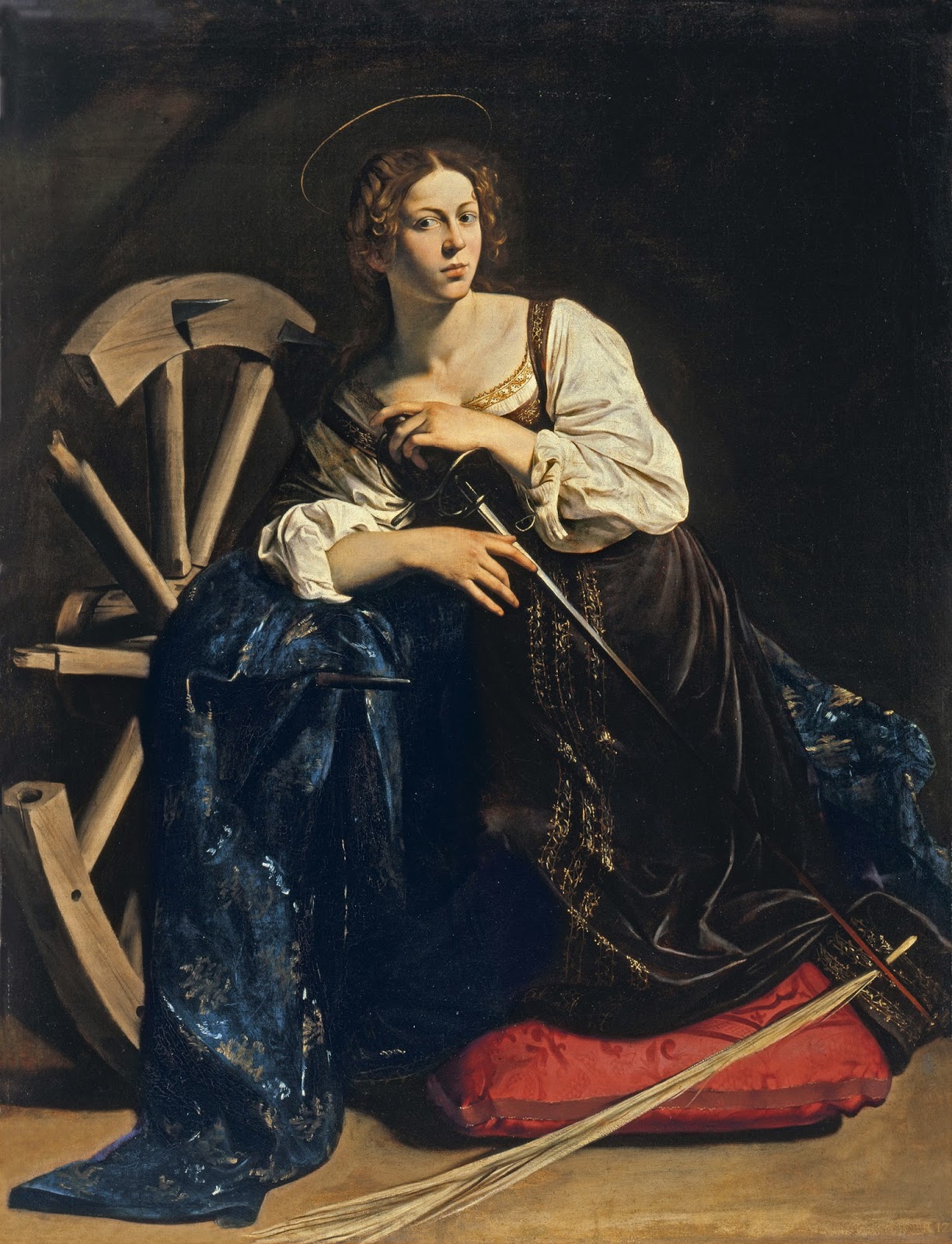
November 25: St. Catherine of Alexandria, V., M., III Class

Today, in the 1962 Dominican Rite Calendar, we celebrate the feast of St. Catherine of Alexandria, Virgin and Martyr.  The feast is III Class, so the ordinary office is prayed according to the rubrics.

Prior to the mid-20th Century revisions of the calendar, her feast was celebrated as a Totum Duplex with an octave (December 2), and her office contained a partial set of propers (the office did not include proper antiphons for the psalms of Matins, and only included three of the original nine responsories).  The antiphon at 1st Vespers for her feast in the 1909 Breviarium S.O.P. was "Hail! O Catherine, thou gem of virgins.  Hail!  O glorious spouse of the King of kings."

Due to the circumstances of her martyrdom, as one defending the Faith against pagans, and the fact that she is reputed to have been a philosopher, she has traditionally been referred to as one of the two "protectresses" of the Order, the other being St. Mary Magdalene.  In a future post, I will give the account of their intervention in the miracle of St. Dominic at Soriano.

Saturday, August 5, 2023

LOST TRADITIONS: August 5 - 11: Octave of Our Holy Father St. Dominic

Prior to the revision of the Breviary instituted by Pope Pius XII, the Octave of Our Holy Father St. Dominic would be celebrated from August 5 till August 11.   This is one of the many octaves of the Dominican saints that were casualties of the liturgical revisions of the mid-20th centuries.  Not all of the Dominican saints had "solemn" octaves after their feast day, but the major ones like St. Dominic, St. Catherine of Sienna, St. Thomas Aquinas, and St. Peter Martyr did.

Once again, I will restate my bewilderment at the Order giving up some of these wonderful feast days on their calendar, when the calendar was updated in 1961.  Even if they wanted to reduce the sanctorale a bit, to make room for new saints and the ferial office, they could still mark the octave of our Holy Father's feast day with a commemoration at Lauds and Vespers.

Saturday, January 28, 2023

LOST FEASTS: January 28: Translation of the Relics of St. Thomas Aquinas

 One of the casualties of the revision of the Breviary undertaken by St. Pius X, was the feast of the Translation of the Relics of St. Thomas Aquinas.  To commemorate the transferal of the Angelic Doctor's relics to Toulouse on January 28, 1369, the general chapter of that year, with the permission of Pope Urban V, instituted a liturgical feast on January 28.  The feast was given the rank of totum duplex.  A commemoration was also made of the "second feast" of St. Agnes on this day.


Monday, October 31, 2022

LOST FEASTS: October 31 - Commemoration of the Holy Relics


One of the great tragedies of the 20th century liturgical changes was the "Romanization" of the Dominican calendar that occurred in the revision of 1960, and which is codified in the calendar of the 1962 Breviarium iuxta ritum sacri ordinis praedicatorum. Many wonderful Dominican feasts were removed from the liturgical calendar of the Order, including those of many Dominican blessed's and many other feasts that were particular to the Dominican Order.  One such feast was the Feast of the Holy Relics.

As noted in the Martyrology of the Sacred Order of Friars Preachers (Bonniwell, 1955), this feast was a commemoration of "holy martyrs and of the other saints, whose bodies or relics are preserved in our churches." In the 1909 Breviarium iuxta ritum sacri ordinis praedicatorum the feast is celebrated on October 30, however in the 1924 Breviarium S.O.P. it appears on October 31, the Vigil of All Saints Day, and remained there until it was removed in 1960. The feast had the rank of a totum duplex feast, which in 1962 would have been considered a 1st Class Feast. For the Office, everything was taken from the Common of Many Martyrs, except the Collect (see below), and lessons 4, 5, and 6 at Matins, which were taken from a tract by St. John Damascene's "De Fide Orthodoxa" . A commemoration of St. Quintinus was also made. Interestingly, this feast superseded the Vigil of All Saints at Matins, as noted in the 1924 Breviarium S.O.P., which states "De Vigilia Sanctorum in Officio nihil fit" at the end of the Office.

Sunday, September 25, 2022

LOST FEAST: September 25: Commemoration of Our Holy Father St. Dominic in Suriano

Prior to the revision of the liturgical calendar of the Order initiated in 1960, the feast of the Commemoration of Our Holy Father St. Dominic in Suriano would be celebrated today, if it were not a Sunday.  The feast was always a totum duplex feast, equivalent to a Ist Class feast in the 1962 breviary classification system.    I know I complain often about how so many feasts were removed from the Dominican calendar, but this one really baffles me, as it is such a wonderful way to pay tribute to the patronage of St. Dominic, our Lady, and the two (2) "unofficial" patronesses of the Order, St. Mary Magdalene and St. Catherine of Alexandria.

The feast was traditionally celebrated on September 15, and the Feast of the Seven Dolors or Our Lady was celebrated on the 3rd Sunday of the month of September.  However, I believe, when the feast of the Seven Dolors was fixed on September 15, this feast was transferred to September 25 until it was deleted from the calendar.

Thursday, August 11, 2022

LOST FEAST: August 11: The Octave of our Holy Father St. Dominic

Prior to the revision of the Breviary and liturgical calendar instituted by Pope St. Pius XII, the Octave of Our Holy Father St. Dominic would be celebrated today, August 11.  This would be the final act in our long celebration of the feast of St. Dominic.  A fitting tribute to the saintly founder of the Order of Preachers, if I do say so myself.  When you add up all of the preparation (the 15 Tuesdays, the Novena, the feast itself, the commemoration in the octave, and finally, the octave day itself) it is a sure and salutary means of developing a loving devotion to our holy father through our liturgical celebrations.

In the pre-1962 Breviarium S.O.P.'s, the feast had the rank of "solemne", which would be considered at least a 2nd Class Feast in the ranking system that was adopted with the 1962 breviary.  For Lauds, Vespers, and the little hours, the office of the feast was prayed.  At Lauds, a commemoration was made of St. Tiburtius.  At Matins the office was that of three (3) lessons.  For the first nocturn, the responsories are proper, and the lessons from the previous Sunday are used.  At the second nocturn, the lessons and the responsories are proper; the lessons being taken from the life of St. Dominic by Theodoric.  The third nocturn is like the first, with the responsories being proper, but the Gospel and homily on the Gospel are taken from the previous Sunday.

At Pretiosa, on August 10, the octave was announced thus "The Octave day of our holy Father Dominic. A solemn octave."  Even though the feast day is no longer on the calendar, I pray the office of St. Dominic anyway, since I am only displacing a ferial day.

Friday, August 5, 2022

LOST TRADITIONS: August 5 - 11: Octave of Our Holy Father St. Dominic

Prior to the revision of the Breviary instituted by Pope Pius XII, the Octave of Our Holy Father St. Dominic would be celebrated from August 5 till August 11.   This is one of the many octaves of the Dominican saints that were casualties of the liturgical revisions of the mid-20th centuries.  Not all of the Dominican saints had "solemn" octaves after their feast day, but the major ones like St. Dominic, St. Catherine of Sienna, St. Thomas Aquinas, and St. Peter Martyr did.

Once again, I will restate my bewilderment at the Order giving up some of these wonderful feast days on their calendar, when the calendar was updated in 1961.  Even if they wanted to reduce the sanctorale a bit, to make room for new saints and the ferial office, they could still mark the octave of our Holy Father's feast day with a commemoration at Lauds and Vespers.

Monday, December 6, 2021

December 6: St. Nicholas, B., C., III Class

Per tradition, I always post on what I see as "links" between St. Nicholas, who's feast we celebrate today, and the Dominican Order.  The feast of St. Nicholas, Bishop of Myra, is one of my favorite non-Dominican feasts in the liturgical calendar.  It holds the liturgical rank of III Class, as in the Roman Rite, but unlike the latter rite the Dominican Breviary contains a near-complete set of propers, as if the feast were II Class (you can download the text of the propers here, taken from the 1967 English Translation of the Breviarium S.OP.).

I have stumbled across a number of connections between St. Nicholas and our holy Order.  I wrote a post about how the feast of St. Nicholas was elevated to a totum duplex (1st Class) feast.  The next year, I did a post on how the famous mystical experience which ended St. Thomas Aquinas' prolific theological writing career occurred on the feast of St. Nicholas, right after the Angelic Doctor finished offering the Mass of this saint.  I also posted on the fact that, when St. Dominic was nearing death, and was too ill to walk, he was carried by the brethren by stretcher to the Church of St. Nicholas in Bologna.  And there, surrounded by his fellow friars, he passed to his eternal reward.  Finally, in 2018, I posted on a scholarly article which suggested that the famous O lumen ecclesiae antiphon for the office of St. Dominic may have borrowed heavily from an existing antiphon for...you guessed it, the office of St. Nicholas (O Christi Pietas).  You can find it here.

As always, I remind anyone who reads this blog to check out the website of a wonderful organization called The St. Nicholas Center, who contacted me two years ago to ask if they could include my post from last year on St. Nicholas and the Dominicans on their website.  I was happy to oblige.  This organization seeks to promote and educate the world on this wonderful saint, who is the inspiration for Santa Claus.

Prayer

O God, you adorned the blessed bishop Nicholas with countless miracles; grant, we beseech you, that through his merits and prayers, we may be delivered from the flames of hell.  Through our Lord...

Thursday, November 25, 2021

November 25: St. Catherine of Alexandria, V., M., III Class

Today, in the 1962 Dominican Rite Calendar, we celebrate the feast of St. Catherine of Alexandria, Virgin and Martyr.  The feast is III Class, so the ordinary office is prayed according to the rubrics.

Prior to the mid-20th Century revisions of the calendar, her feast was celebrated as a Totum Duplex with an octave (December 2), and her office contained a partial set of propers (the office did not include proper antiphons for the psalms of Matins, and only included three of the original nine responsories).  The antiphon at 1st Vespers for her feast in the 1909 Breviarium S.O.P. was "Hail! O Catherine, thou gem of virgins.  Hail!  O glorious spouse of the King of kings."

Due to the circumstances of her martyrdom, as one defending the Faith against pagans, and the fact that she is reputed to have been a philosopher, she has traditionally been referred to as one of the two "protectresses" of the Order, the other being St. Mary Magdalene.  In a future post, I will give the account of their intervention in the miracle of St. Dominic at Soriano.

Saturday, October 30, 2021

LOST FEASTS: October 31 - Commemoration of the Holy Relics


One of the great tragedies of the 20th century liturgical changes was the "Romanization" of the Dominican calendar that occurred in the revision of 1960, and which is codified in the calendar of the 1962 Breviarium iuxta ritum sacri ordinis praedicatorum. Many wonderful Dominican feasts were removed from the liturgical calendar of the Order, including those of many Dominican blessed's and many other feasts that were particular to the Dominican Order.  One such feast was the Feast of the Holy Relics.

As noted in the Martyrology of the Sacred Order of Friars Preachers (Bonniwell, 1955), this feast was a commemoration of "holy martyrs and of the other saints, whose bodies or relics are preserved in our churches." In the 1909 Breviarium iuxta ritum sacri ordinis praedicatorum the feast is celebrated on October 30, however in the 1924 Breviarium S.O.P. it appears on October 31, the Vigil of All Saints Day, and remained there until it was removed in 1960. The feast had the rank of a totum duplex feast, which in 1962 would have been considered a 1st Class Feast. For the Office, everything was taken from the Common of Many Martyrs, except the Collect (see below), and lessons 4, 5, and 6 at Matins, which were taken from a tract by St. John Damascene's "De Fide Orthodoxa" . A commemoration of St. Quintinus was also made. Interestingly, this feast superseded the Vigil of All Saints at Matins, as noted in the 1924 Breviarium S.O.P., which states "De Vigilia Sanctorum in Officio nihil fit" at the end of the Office.

Friday, October 8, 2021

LOST TRADITIONS: October 7-14 Octave Of B.V.M. Of The Rosary


If the Order had maintained its system of keeping the octaves of its major feasts, the Octave of the B.V.M. of the Rosary would be celebrated from October 8 till October 14. This is one of the many octaves that the Dominicans included in their calendar, as a means of prolonging the celebration of saints (or in this case, their Patroness), that were casualties of the revisions of Dominican calendar that took place in the middle of the 20th Century. Not all of the Dominican saints had "solemn" octaves after their feast day, but the major ones like St. Dominic, St. Catherine of Sienna, St. Thomas Aquinas, and St. Peter Martyr did.

Actually, this feast was originally celebrated on the 1st Sunday of October. That is where it appears in the 1909 calendar. This means that the octave was celebrated on the 2nd Sunday of October. You can see the problem that was caused, by assigning feasts of the sanctorale to the Sundays of the year. This, along with the numerous totum duplex feasts of the saints of th eOrder and others led to the situation where the Sundays were hardly ever celebrated as such. Moving the date of the feast to October 7 (the actual day of the Battle of Lepanto) was a nice solution that preserved the solemn celebration of the feast, and avoided the interruption of the temporale.

Every day during the octave, a commemoration was made at Lauds and Vespers using the proper versicle/responsory, Benedictus/Magnificat antiphons provided in the sanctorale.  The versicles and responses come from the feast, as does the antiphon at Lauds (which comes from 1st Vespers of the feast), but I have not been able to tell where the antiphon for Vespers comes from.


Ad Bened. ant.  Speciosa facta es et suavis in deliciis virginitatis sancta Dei genitrix: quam videntes filiae Syon vernantem in floribus rosarum et liliis convalium. Beatissimam praedicaverunt,et regine laudaverunt eam.

Ad Bened. ant.  The holy Mother of God is beautiful and comely in the delights of virginity. When they saw her flourishing among the roses and lilies of the valleys, the maidens of Sion called her happy and queens praised her

V. Elegit eam Deus, et praeelegit eam. R. Et habitare eam facit in tabernaculo suo.

V. God has chosen her, and has given her preference.  R. He gives her his home to dwell in.

Oratio.
Deus, cuius Unigenitus per vitam, mortem et resurrectionem suam nobis salutis aeternae praemia comparavit: concede, quaesumus; ut haec mysteria sacratissimo beatae Mariae Virginis Rosario recolentes, et imitemur quod continent, et quod promittunt, assequamur.  Per Dominum nostrum…

Prayer
O God, whose only begotten Son, by His life, death, and resurrection, has purchased for us the rewards of eternal life, grant, we beseech thee, that by meditating on these mysteries of the most holy Rosary, of the Blessed Virgin Mary, we may imitate what they contain and obtain what they promise.  Through the same…

Ad Magnif. ant.  Sancta Maria virginum piissima suscipe vota servulorum assidua lapsos erige errantes corrige trementes corrobora   pusillanimes conforta ut tibi semper referamus laudes quam Dei summi colimus Genetricem.

Ad Magnif. ant.  Holy Mary, most tender of virgins, receive the constant prayers of your little servants: raise up the fallen, correct the wayward, strengthen the trembling, comfort the faint-hearted: so that we may ever offer praises to you whom we honor as the Mother of the Most High God.

V. Regina sacratissimi Rosarii ora pro nobis. R. Ut digni efficiámur promissiónibus Christi.

V. Queen of the most holy Rosary pray for us.  R. That we may be made worthy of the promises of Christ.

Thursday, August 5, 2021

LOST TRADITIONS: August 5 - 11: Octave of Our Holy Father St. Dominic

Prior to the revision of the Breviary instituted by Pope Pius XII, the Octave of Our Holy Father St. Dominic would be celebrated from August 5 till August 11.   This is one of the many octaves of the Dominican saints that were casualties of the liturgical revisions of the mid-20th centuries.  Not all of the Dominican saints had "solemn" octaves after their feast day, but the major ones like St. Dominic, St. Catherine of Sienna, St. Thomas Aquinas, and St. Peter Martyr did.


Once again, I will restate my bewilderment at the Order giving up some of these wonderful feast days on their calendar, when the calendar was updated in 1961.  Even if they wanted to reduce the sanctorale a bit, to make room for new saints and the ferial office, they could still mark the octave of our Holy Father's feast day with a commemoration at Lauds and Vespers.

On August 5, at Pretiosa, we read in the Martyrology for August 6 the commemoration of his death on the actual day that he passed to his eternal reward:
At Bologna, the birthday of St. Dominic, confessor and founder of the Order of Friars Preachers. He was a man of great renown for holiness and learning. Until death he preserved without stain his virginity, and by the singular grace of his merits raised three dead men to life. By his preaching he curbed heresies, and established many persons in a religious and godly manner of life. He died on this day, but his festival, by an ordinance of Pope Paul IV, is celebrated on August 4.
At the very least, the extension of Our Holy Father's solemn feast day is a wonderful way in which to deepen our devotion to him.  Every day during the octave, a commemoration was made at Lauds and Vespers using the proper versicle/responsory, Benedictus/Magnificat antiphons from the Dominican Little Office of the Blessed Virgin Mary, and the collect from the feast.